Safe and Secure Autonomous Driving

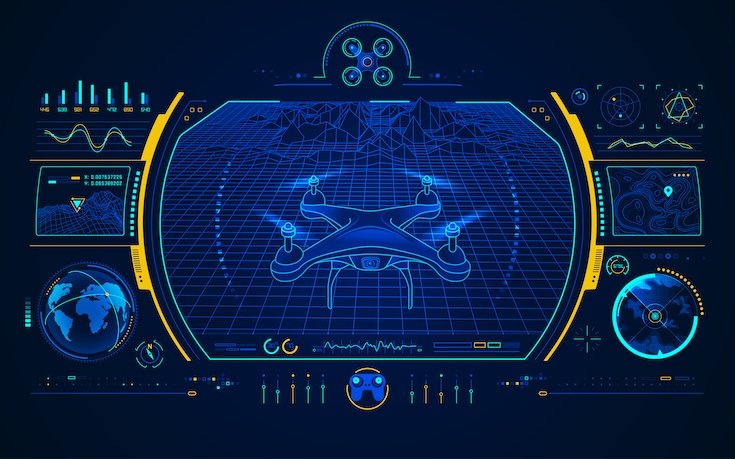
Unmanned aerial vehicle (UAV) operations are subject to significant uncertainties arising from environmental variability, nonlinear aerodynamic forces, payload changes, and noise in control signals. In rapidly changing operational scenarios, maintaining precise and stable tracking becomes a considerable challenge.
Intractābilis has developed an end-to-end deep reinforcement learning (DRL) based controller that processes raw sensory input directly, eliminating the need for intermediate object detection policies. Unlike classical controllers, which rely on fixed models and require accurate dynamic representations, our DRL approach can adapt in real time by learning from past experience, continually refining its policy without modification to the underlying system components. This data-driven adaptability reduces dependence on highly accurate physical models, enabling robust performance even when the model cannot fully capture the complexities of the control system.
The system learns its tracking policies through carefully designed reward functions, trained in domain-randomised simulation environments ranging from simple box-like arenas to large-scale, visually degraded settings resembling subterranean conditions. By jointly optimising feature extraction and control within an end-to-end architecture, our solution bypasses the limitations of detector-based approaches and delivers a robust, adaptive, and sensor-agnostic tracking solution.

End-to-end models for autonomous driving employ deep learning architectures to map raw sensor inputs such as camera imagery and LiDAR readings, to control outputs including steering, acceleration and braking. While these models perform effectively in many operational contexts, they often struggle when confronted with rare or unpredictable edge cases.
Intractābilis has developed an advanced multi-modal safety agent designed to enhance decision-making in such challenging scenarios. The system integrates visual features with language-based representations via visual–language adapters, enabling a more comprehensive understanding of complex driving environments.
By leveraging large-scale, pre-trained Visual–Language Models (VLMs), the agent benefits from common representations and broad knowledge derived from extensive multi-modal datasets. This approach, combined with zero-shot learning, delivers strong generalisation capabilities, allowing the agent to interpret and respond effectively to unfamiliar situations. Through its pre-trained semantic understanding, the system can draw inferences from novel data without requiring extensive retraining.
The solution further incorporates fine-tuned VLMs trained on annotated datasets specifically targeting the detection of potential hazards in edge cases. This unified visual and linguistic processing supports real-time hazard recognition, richer scene comprehension, and more reliable handling of exceptional scenarios. By seamlessly connecting visual and textual modalities, the Intractābilis safety agent strengthens situational awareness, reduces risk, and contributes to safer, more efficient autonomous driving.
Our autonomous driving portfolio is built with real-world deployment in mind. Our solutions prioritise transparency, efficiency, and validation in live vehicle stacks. We enable automotive OEMs, Tier-1 suppliers, and ADAS developers to deploy smarter, safer, and more cost-effective autonomy.